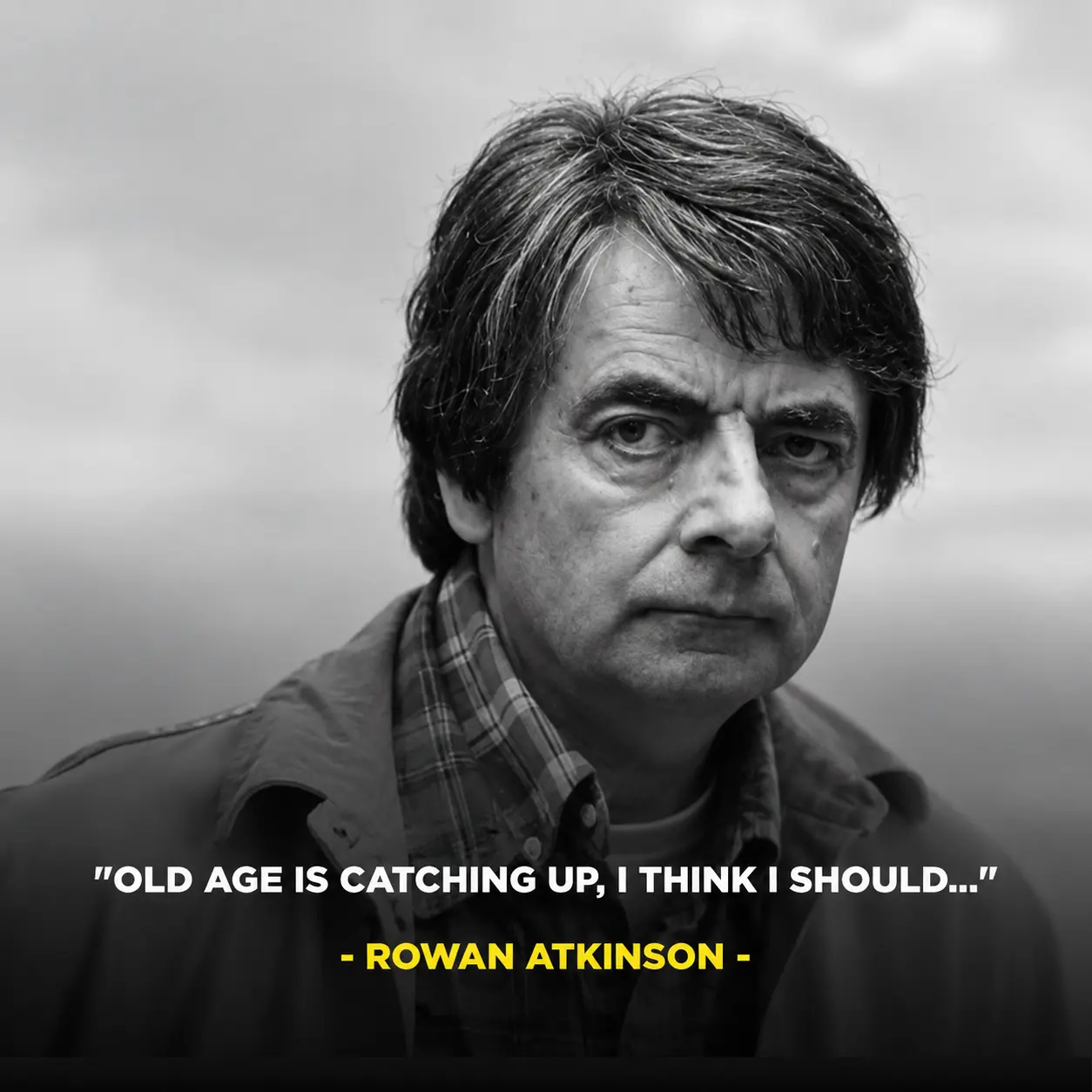
Rowan Atkinson breaks his silence at 71: "Old age is catching up, I think I should..."
A short, unexpected statement from the legendary British actor has left fans everywhere completely in shock. Is this a final goodbye to the big screen, or the start of a whole new chapter?
👈 Read his full response and official statement here.
For more than four decades, Rowan Atkinson has occupied a rare position in entertainment. He is not simply the actor behind one successful television character or a performer remembered for a handful of popular films. Through Mr. Bean, Blackadder, Johnny English, and numerous other appearances, Atkinson became part of the cultural memory of generations.
Now, however, a brief statement circulating under his name has prompted a very different conversation.
“Old age is catching up, I think I should...”
It is the unfinished part that has attracted so much attention.
Should what?
Retire?
Slow down?
Step away from acting?
Spend more time away from the cameras?
Or simply change the way he approaches the next stage of his career?
At 71, Atkinson has reached an age when questions about retirement inevitably appear. Yet the material accompanying this viral quotation does not provide an original interview, complete statement, or identifiable announcement from Atkinson confirming what he supposedly intended to say.
So the missing words should not simply be invented.
There is currently nothing in the supplied material establishing that this is Atkinson's “final goodbye” to acting. Nor does the fragment prove that he has decided to retire.
What it does provide is an opportunity to consider an extraordinary career — and why the possibility of Atkinson eventually stepping away feels surprisingly emotional to so many people.
For millions, the story begins with Mr. Bean.
When the character first appeared on British television in 1990, the concept seemed almost impossibly simple. Bean was an eccentric man confronting ordinary situations with extraordinarily questionable solutions.
Atkinson didn't need elaborate dialogue.
His face carried the story.
A raised eyebrow could reveal that Bean had developed another terrible idea. A nervous glance could show that he knew he was in trouble. A tiny smile could signal the dangerous confidence that usually appeared immediately before everything went wrong.
That visual style helped Mr. Bean achieve something remarkable.
He crossed languages.
Viewers did not need fluent English to understand the comedy. Embarrassment needed no translation. Neither did panic, frustration, pride, jealousy, or the ridiculous satisfaction of believing you have solved a problem while everyone around you can see that you have made it considerably worse.
Mr. Bean became an international phenomenon.
But Atkinson's career had already demonstrated considerable range before Bean arrived.
His early work in British comedy, including Not the Nine O'Clock News, established him as a performer with an unusual combination of intelligence, timing, vocal ability, and physical control.
Then came Blackadder.
Edmund Blackadder showed audiences almost the opposite of Mr. Bean.
Where Bean relied heavily on silence, Blackadder relied on words.
He was sarcastic, calculating, impatient, and verbally ruthless. Atkinson could deliver elaborate comic dialogue with the same precision he later brought to a silent facial expression.
That versatility became one of the defining characteristics of his career.
Years later, Johnny English gave him another globally recognizable role.
The secret agent was spectacularly confident and frequently spectacularly wrong. Atkinson again transformed incompetence into comedy, creating a character whose seriousness made the disasters surrounding him even funnier.
Across all these projects, Atkinson developed an unusual relationship with time.
His characters barely seem to age.
An old Mr. Bean episode can be played today and suddenly viewers are looking at the same performer they remember from decades earlier.
The brown tweed jacket remains.
Teddy remains.
The Mini remains.
The joke remains.
But outside the screen, time continues moving.
That is why a phrase such as “old age is catching up” can feel unexpectedly powerful when attached to Atkinson.
For longtime fans, his aging becomes a reminder of their own.
The child who watched Mr. Bean after school may now have children.
The teenager who discovered Blackadder may now be approaching retirement.
The family members who once sat together watching Atkinson may no longer all be there.
Entertainment can preserve a moment.
Life cannot.
And perhaps that is why retirement speculation surrounding beloved performers often becomes emotional even before there is an actual retirement announcement.
People aren't only worried about losing future films.
They are confronting the passage of time.
Yet aging does not automatically mean disappearing.
Many performers eventually change their workload rather than abandoning their profession entirely. Some become more selective. Others focus on projects that genuinely interest them instead of maintaining a relentless production schedule.
Atkinson's career has never depended on appearing everywhere constantly.
Part of his longevity comes from the fact that his most famous work continues circulating without requiring him to remain permanently in public view.
Mr. Bean effectively developed a life of his own.
Streaming and social media introduced old sequences to new generations. The character's visual style turned out to be exceptionally compatible with modern digital platforms.
A scene created decades ago can appear on a phone today and make someone laugh immediately.
That means Atkinson's cultural presence no longer depends entirely on what he does next.
His legacy already exists.
That does not mean audiences are ready to say goodbye.
The idea of a final Johnny English performance, a last major screen role, or a definitive retirement statement would inevitably attract enormous attention.
But those possibilities should not be transformed into facts before Atkinson himself confirms them.
The incomplete quotation currently circulating creates suspense precisely because it leaves the conclusion open.
Perhaps that is where it should remain.
Only Atkinson can complete the sentence.
And if he eventually does decide to reduce his workload, that decision would hardly erase what came before.
Few performers create one character remembered internationally.
Atkinson created several.
Few comedians succeed equally through elaborate language and almost complete silence.
Atkinson did.
Few television characters remain immediately understandable across generations, cultures, and languages decades after their debut.
Mr. Bean does.
There is also something fitting about the possibility of Atkinson approaching his later years on his own terms.
His career was never conventional in the first place.
Before comedy became his profession, he studied electrical engineering. His route toward becoming one of Britain's most recognizable entertainers was hardly predictable.
Yet that engineering background almost seems appropriate when examining the precision of his comedy.
Atkinson's movements are controlled.
His pauses are calculated.
His expressions arrive at exactly the right moment.
The chaos is carefully constructed.
That craftsmanship is one reason the work survived.
So what should Rowan Atkinson do next?
The answer belongs entirely to him.
He may continue acting.
He may become more selective.
He may pursue different creative interests.
And eventually, like every performer, he may decide that the time has arrived to step away.
None of those possibilities diminish his legacy.
Fans also do not need to wait for an official retirement announcement to express appreciation.
Atkinson has already provided decades of laughter.
He has given families scenes they watched together.
He has created characters people recognize instantly.
He has demonstrated that sometimes the funniest dialogue is an elaborate insult — and sometimes the funniest dialogue is no dialogue at all.
Most importantly, his work has survived the era that created it.
Television changed.
Cinema changed.
Audiences changed.
Technology changed.
Rowan Atkinson's comedy continued finding viewers.
If the unfinished statement about aging eventually turns out to be authentic, perhaps its most significant message will not be about saying goodbye.
Perhaps it will simply acknowledge something every person eventually confronts:
Time moves forward.
Careers change.
Priorities change.
And there comes a point when deciding what not to do can become just as important as deciding what comes next.
Until Rowan Atkinson provides a verifiable complete statement, there is no reason to write his farewell for him.
The curtain has not officially fallen simply because an unfinished quotation suggests that he has been thinking about age.
And even whenever that curtain eventually does fall, one thing will remain unchanged:
Rowan Atkinson made generations of people laugh — and no retirement announcement can take those moments away.