KURT RUSSELL IS FACING THE TOUGHEST BATTLE OF HIS LIFE — AND HE NEEDS HIS FANS NOW....
FULL STORY IN THE FIRST COMMENT 👇
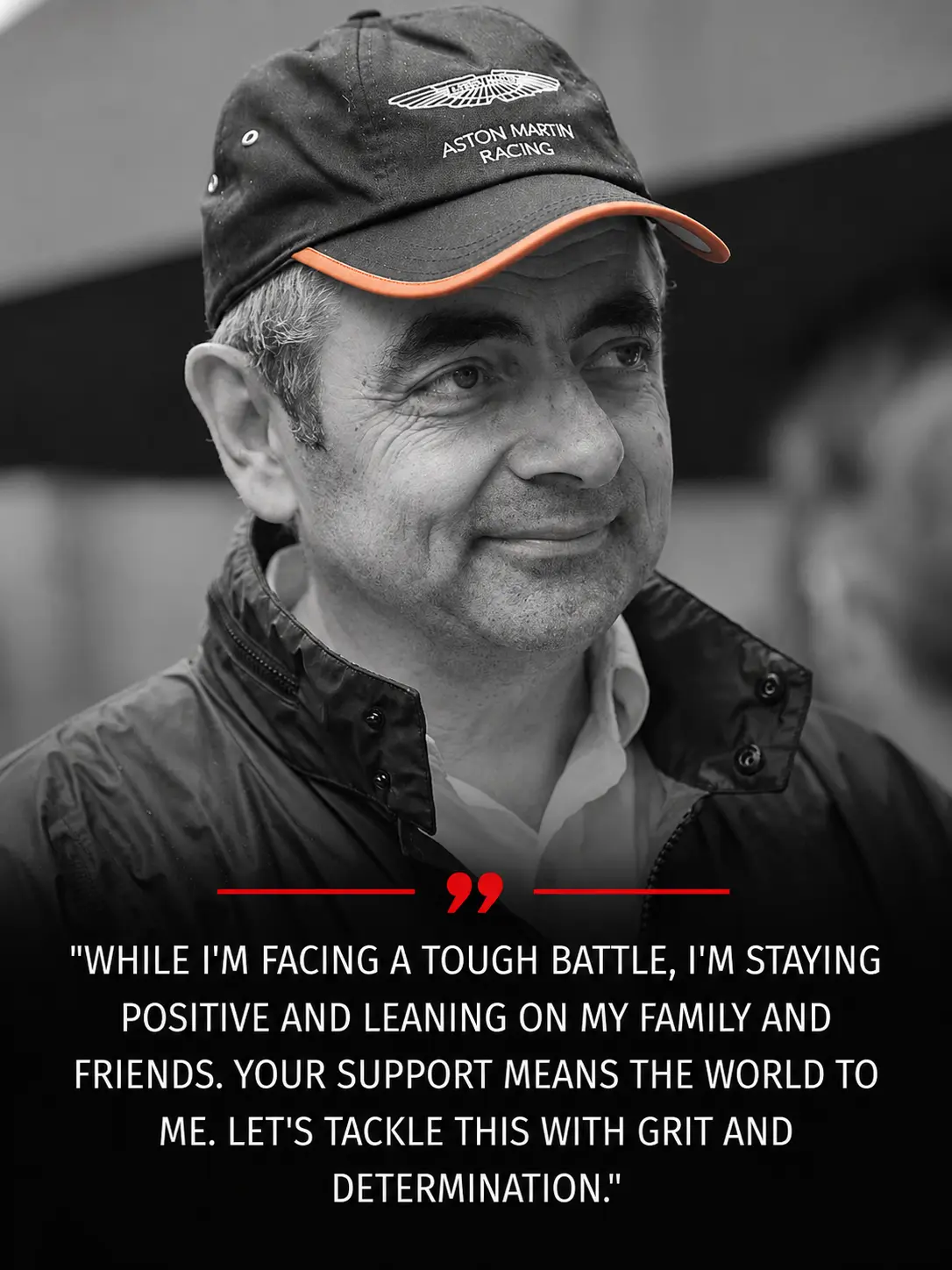
For more than four decades, Rowan Atkinson has given the world something priceless: laughter. Through unforgettable characters, perfectly timed expressions, and an extraordinary ability to communicate without saying a word, the legendary British performer has become part of the lives of millions of people.
Now, however, an emotional message circulating around his name has created a very different atmosphere.
Instead of celebrating another classic Mr. Bean moment or looking back at the success of Blackadder and Johnny English, fans are being confronted with an alarming suggestion — that Atkinson is supposedly facing “the toughest battle of his life.”
It is a powerful phrase.
It is also a phrase that immediately raises questions.
What battle?
Is it connected to his health?
Is his family experiencing a difficult period?
Has something happened privately that has not yet been fully explained?
The material accompanying the claim does not provide answers to those questions. It does not identify a diagnosis, accident, hospitalization, family crisis, or official statement from Atkinson or his representatives.
For that reason, it would be wrong to manufacture a devastating explanation simply to complete the story.
What is undeniably real, however, is the enormous affection surrounding Rowan Atkinson — and the reason so many people would immediately want to support him if he genuinely were experiencing a difficult chapter.
For generations of viewers, Atkinson is inseparable from Mr. Bean.
When the character first appeared on British television in 1990, few could have predicted just how far he would travel.
Mr. Bean was unusual because he needed relatively few words.
Atkinson's face did the talking.
A suspicious glance could communicate an entire thought.
A raised eyebrow could announce that another ridiculous plan was forming.
A nervous smile could tell viewers that Bean knew he was in trouble but had absolutely no intention of admitting it.
That style of physical comedy gave the character an enormous international advantage.
Audiences didn't need fluent English.
They simply needed to recognize human behavior.
Embarrassment is universal.
So is frustration.
So is panic.
And everyone understands the ridiculous confidence of someone who believes he has solved a problem while actually making it considerably worse.
Atkinson transformed those universal experiences into comedy.
Soon, Mr. Bean was no longer simply a British television character. He became a global cultural figure.
But Atkinson's career had begun long before Bean.
His journey toward entertainment was itself unusual. He studied electrical engineering, an academic background that might seem completely disconnected from comedy.
Yet watch Atkinson perform closely and the connection becomes strangely appropriate.
His comedy is engineered with remarkable precision.
The timing of a movement matters.
The duration of a pause matters.
The exact moment his eyes change direction matters.
What appears spontaneous on screen is often the product of extraordinary control.
Atkinson demonstrated another side of that control through Blackadder.
Edmund Blackadder was almost the opposite of Mr. Bean.
Bean could create comedy through silence.
Blackadder could destroy someone with a sentence.
Sarcasm, elaborate insults, frustration, and verbal precision were central to the character, allowing Atkinson to demonstrate that his talent extended far beyond physical comedy.
Then came Johnny English.
Once again, Atkinson found a character capable of reaching international audiences.
Johnny English believed he was an exceptional secret agent despite overwhelming evidence suggesting otherwise. That gap between confidence and competence created another perfect vehicle for Atkinson's particular comedic style.
Across all those roles, something extraordinary happened.
Atkinson stopped being merely an entertainer people watched.
He became part of their memories.
A child watching Mr. Bean in the 1990s may now be a parent showing the same episode to their own children.
Someone may remember watching Atkinson with a mother or father who is no longer alive.
Another person may remember laughing with siblings during a childhood that now feels impossibly distant.
The episode hasn't changed.
The people watching it have.
That is one reason emotionally charged stories involving Atkinson can generate such intense reactions.
When people worry about him, they are sometimes responding not only to the performer but also to everything his work represents in their own lives.
Laughter becomes attached to memory.
Memory becomes attached to people.
And eventually, a famous stranger can feel surprisingly familiar.
But that emotional connection also creates a responsibility not to turn uncertainty into tragedy.
Calling something “the toughest battle of his life” can imply an extremely serious situation. Without additional evidence, however, nobody should conclude that Atkinson is fighting a life-threatening illness or experiencing another specific crisis.
Concern does not require speculation.
Support does not require a diagnosis.
And affection does not require invading someone's privacy.
If Atkinson ever chooses to disclose a difficult personal situation, his own words should lead the conversation.
Until then, audiences can still reflect on why they care so deeply.
Perhaps part of the answer lies in Atkinson's unusual relationship with vulnerability.
His characters are constantly vulnerable, although usually in comedic ways.
Mr. Bean desperately wants to maintain control even when everything is collapsing around him.
Johnny English believes he is commanding every situation while disaster unfolds behind him.
Audiences laugh because they recognize something human underneath the exaggeration.
Everyone has experienced embarrassment.
Everyone has made mistakes.
Everyone has pretended to understand something they didn't.
Everyone has experienced moments when life refused to follow the plan.
Atkinson turned those uncomfortable experiences into something joyful.
That is an extraordinary gift.
It also explains why fans may want to return some of that joy when they believe the man behind the characters needs encouragement himself.
The entertainment landscape has transformed dramatically during Atkinson's career.
Television changed.
Cinema changed.
The internet arrived.
Streaming transformed how audiences discover older programs.
Social media created a world where a decades-old comedy clip can suddenly reach millions of viewers again.
Yet Mr. Bean survived every technological shift.
In some ways, the character was almost perfectly suited to the digital age before anyone knew what the digital age would become.
Short scenes.
Immediate visual humor.
Minimal linguistic barriers.
A recognizable face.
That has allowed younger generations to discover Atkinson long after the original television broadcasts.
Few entertainers achieve that kind of longevity.
And perhaps that is why the phrase “he needs his fans now” feels so emotionally effective.
For decades, audiences came to Rowan Atkinson when they needed laughter.
After difficult days, they watched Mr. Bean.
During stressful periods, they returned to familiar episodes.
Families sat together and laughed.
Friends shared clips.
Children discovered the jokes their parents remembered.
If Atkinson were genuinely experiencing a difficult period, many fans would naturally feel that it was their turn to send something back.
Not money.
Not intrusive questions.
Simply kindness.
A message of appreciation.
A memory.
A few words wishing him and his family strength and peace.
Those gestures do not require people to pretend that an unconfirmed crisis is established fact.
They can simply celebrate the person whose work mattered to them.
Rowan Atkinson has spent much of his professional life demonstrating that powerful communication does not always require many words.
Perhaps the same principle applies here.
Fans do not need to know every private detail.
They do not need a dramatic explanation.
They do not need to invent what “the toughest battle” means.
Sometimes the simplest message is enough:
Thank you for the laughter, Rowan. Whatever challenges life brings, millions of people around the world are still smiling because of the moments you created.