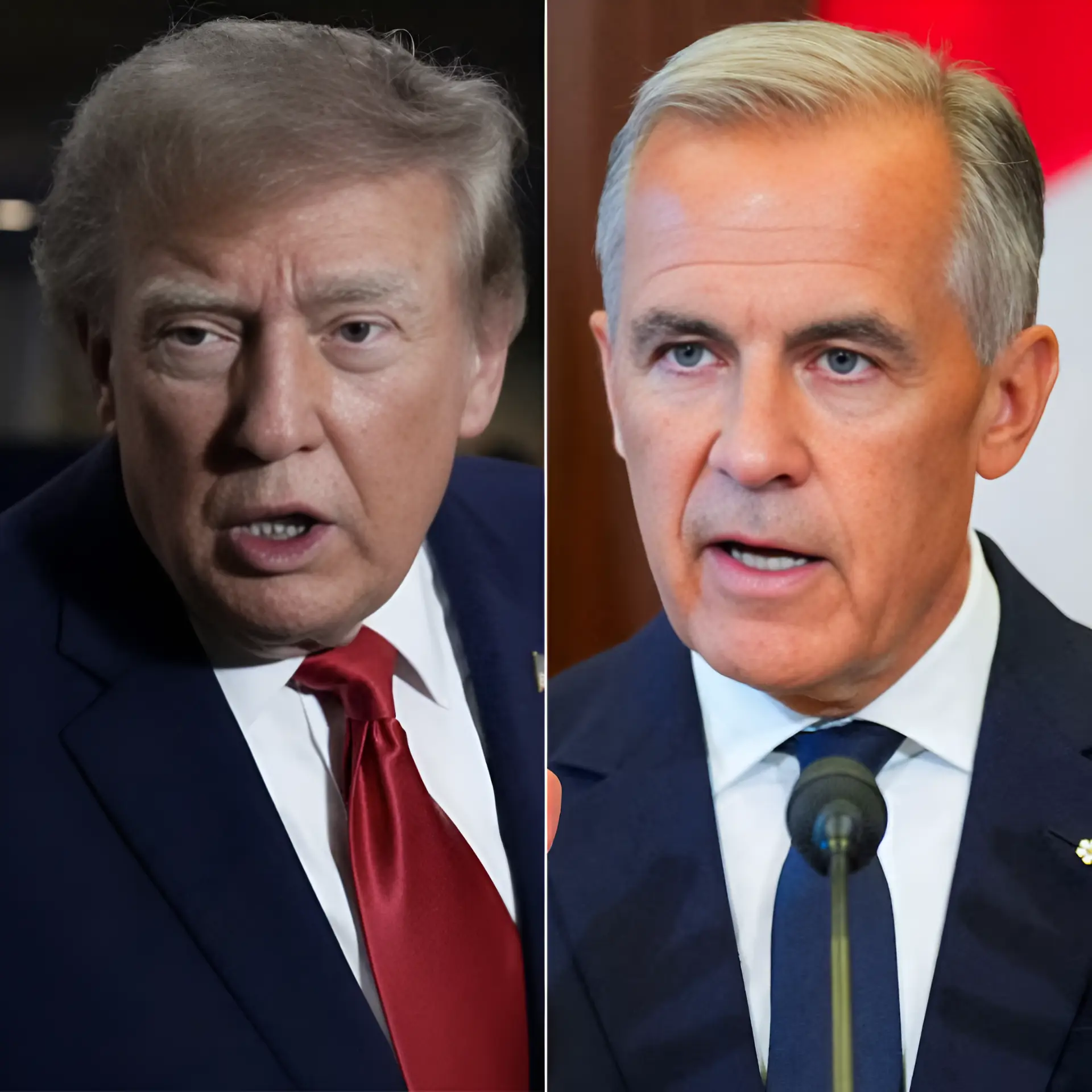
BREAKING: Trump Attacks Prime Minister Mark Carney — and Gets a FIERY Response He Won’t Forget
Donald Trump may have expected a few cutting words to put Canadian Prime Minister Mark Carney on the defensive.
Instead, in this dramatized account, the confrontation became something much bigger — a sweeping argument about Canadian sovereignty, national independence, borders, foreign policy, government transparency, free speech, and the fundamental question of whom elected leaders are supposed to serve.
Carney did not respond with a joke.
He did not answer with a personal insult.
And he did not retreat.
Instead, standing before a packed audience, the Canadian Prime Minister went directly to the heart of the dispute.
“The President of the United States is entitled to his opinion of me,” Carney began. “But Canada is not a satellite state, and Canadian leaders should never be afraid to say so.”
The message was unmistakable.
Whatever disagreements might exist between Ottawa and Washington, Carney’s argument was that Canada must remain responsible for its own decisions.
And that was only the beginning.
What started as a political confrontation quickly expanded into a broader declaration about how Carney believes an independent country should conduct itself in an increasingly unstable world.
“You want to talk about leadership?” he continued. “Leadership means putting the people of your own country first. It means defending your borders. It means protecting free speech. And it means having the courage to tell powerful people the truth, even when they would rather you stayed silent.”
The atmosphere reportedly shifted immediately.
Suddenly, the dispute was no longer merely about Donald Trump and Mark Carney.
It was about sovereignty.
It was about political accountability.
It was about immigration, war, government spending, transparency, and the relationship between powerful institutions and ordinary citizens.
Most importantly, it became a debate about whether elected leaders still remember exactly who put them in office.
A Broader Argument About Leadership
Carney then moved toward foreign policy, raising questions that have become increasingly prominent in political debates across Western democracies.
“How many ordinary families have watched governments spend billions overseas while their own communities struggle?” he asked.
“How many young men and women have been sent into conflicts that politicians were very good at starting, but apparently had no idea how to finish?”
The argument was designed to draw a sharp distinction between international commitments and domestic responsibilities.
Countries inevitably have alliances, security obligations, trade relationships, and strategic interests beyond their borders.
But Carney’s message in this dramatized exchange was that those responsibilities should never erase a government’s primary obligation to its own citizens.
Then came one of the sharpest lines of the entire response.
“Patriotism does not mean blindly agreeing with another country simply because that country is an ally,” Carney said. “A real ally tells you when you are wrong.”
That statement went directly to the complicated relationship between Canada and the United States.
The two countries share one of the world’s most important bilateral relationships. Their economies are deeply connected. They cooperate on defense and security. Millions of people travel across their shared border, while businesses and supply chains operate across both countries.
But close cooperation does not mean identical interests.
And Carney’s argument was straightforward: friendship between countries should not require political obedience.
Canada, in his framing, can remain a close American ally while still disagreeing with Washington.
Respect, he argued, does not require submission.
“Stop Treating the People Like Children”
Carney then shifted his attention from international relations to another issue: government transparency.
His argument was that political leaders cannot continuously demand public trust while withholding information whenever disclosure becomes inconvenient.
“If politicians want the trust of the people, then stop treating the people like children,” Carney said.
“Release the documents. Answer the questions. Tell the truth. Whether it involves government spending, immigration, foreign wars, or powerful individuals with powerful friends — transparency cannot only exist when it is politically convenient.”
It was a direct challenge to a political culture in which governments frequently demand public confidence while simultaneously asking voters to accept that certain decisions cannot be fully explained.
Carney’s message was that accountability cannot be selective.
A government cannot celebrate transparency when disclosure is politically advantageous and abandon it when uncomfortable questions arise.
If citizens are expected to finance government, obey laws, accept national sacrifices, and trust elected officials with enormous authority, then those citizens have a right to demand answers.
That led to perhaps the central declaration of the entire speech.
“I do not work for Washington. I do not work for Brussels. I do not work for multinational corporations, lobbyists, or political celebrities. I was elected to represent the people of Canada, and that is exactly what I intend to do.”
The crowd erupted.
In that moment, the confrontation moved beyond Trump.
Carney was laying out a much broader political philosophy centered on national sovereignty and democratic accountability.
His message was that Canadian policy should ultimately be determined by Canadians — not by foreign capitals, multinational corporations, international pressure, lobbyists, or celebrity political figures.
Respect Is Not Obedience
Then Carney turned directly back toward Trump.
“I respect any leader who fights for his country,” Carney said. “But respect does not mean obedience.”
That distinction became the foundation for the next stage of his argument.
“America should put Americans first. Canada should put Canadians first. Those two things are not contradictory at all. In fact, that is exactly how independent nations are supposed to operate.”
It was an unusually pointed response because Trump has built a substantial portion of his political identity around the concept of “America First.”
Carney effectively took that principle and applied it to Canada.
If an American president can argue that Washington should prioritize American citizens, industries, borders, workers, and strategic interests, Carney’s argument suggested, then a Canadian prime minister should be equally entitled to prioritize Canadian citizens and Canadian interests.
“If ‘America First’ is acceptable in Washington,” he argued, “then ‘Canada First’ should not suddenly become controversial in Ottawa.”
The underlying argument was not necessarily that Canada and the United States must become adversaries.
It was almost the opposite.
Two independent countries should be capable of pursuing their respective national interests while maintaining a productive relationship.
There will inevitably be disagreements.
Trade disputes will happen.
Foreign-policy priorities may diverge.
Immigration policies may differ.
Defense strategies may not always align perfectly.
But disagreement between allies does not automatically mean hostility.
For Carney, at least within this dramatized confrontation, that distinction mattered enormously.
Canada does not need to oppose America simply to demonstrate its independence.
But neither should it automatically follow Washington simply to demonstrate friendship.
Why Are Ordinary Citizens Always Asked to Sacrifice?
Carney then turned toward what he characterized as another major failure of modern political leadership: governments that appear more willing to impose burdens on ordinary citizens than confront powerful institutions.
“Governments lecture taxpayers while wasting their money,” he said.
“They police the words of ordinary people while criminals walk our streets. They tell families to accept declining living standards while politicians continue spending as though there is no tomorrow.”
Then he delivered the conclusion:
“That is what people are angry about.”
The statement connected several political frustrations into a single theme.
Citizens are repeatedly told that difficult sacrifices are necessary.
They are told to accept higher costs.
They are told government programs require more money.
They are told certain policies are unavoidable.
They are told complicated global circumstances demand patience.
But eventually, voters begin asking whether political institutions are making the same sacrifices they demand from everyone else.
That question becomes particularly powerful during periods of economic pressure.
When families struggle with housing, food, energy, transportation, and other everyday expenses, government spending becomes more than an abstract accounting debate.
It becomes personal.
People begin asking where their tax money is going.
They ask whether government priorities match their own.
They ask whether political leaders understand the financial pressures experienced by ordinary households.
And they become increasingly skeptical when those questions receive vague answers.
Carney’s argument was that political leaders ignore that frustration at their own risk.
“You Can Call Me Whatever You Like”
Carney then addressed the personal attacks directly.
“You can call me difficult. You can call me controversial. You can call me whatever you like,” he said.
“But if standing up for Canadian sovereignty, secure borders, free speech, and accountable government makes me inconvenient to powerful people, then I am perfectly comfortable being inconvenient.”
It was a deliberate reframing of political criticism.
Rather than treating controversy as something that necessarily needs to be avoided, Carney presented disagreement as an unavoidable consequence of challenging powerful interests.
The implication was clear: political leaders should not measure their decisions according to whether influential people approve of them.
They should measure those decisions according to whether they serve the citizens they were elected to represent.
That does not mean leaders should ignore criticism.
Democratic politics requires criticism.
It requires scrutiny.
It requires opposition.
But Carney’s argument was that criticism should not automatically force a leader to abandon a position.
Sometimes disagreement is evidence that a genuine political debate is taking place.
And democracies, he suggested, need more genuine debate — not less.
Canada Will Decide Canada’s Future
Carney’s closing message returned to that central democratic principle.
“Countries do not become stronger simply because their politicians agree with one another.”
“They become stronger because their politicians are prepared to argue, challenge power, and always remember who sent them there.”
It was a powerful conclusion because it rejected the idea that political unity always requires political agreement.
Democracy is inherently argumentative.
Opposition parties challenge governments.
Journalists challenge politicians.
Citizens challenge institutions.
Members of parliament challenge one another.
Countries challenge allies when their interests diverge.
That friction can be uncomfortable.
But Carney’s message was that disagreement itself is not necessarily evidence of dysfunction.
Sometimes it is evidence that democratic institutions are functioning exactly as intended.
Trump may have expected Carney to retreat.
Instead, in this dramatized account, the Canadian Prime Minister transformed the confrontation into something resembling a declaration of political independence.
There was no apology.
There was no retreat.
There was no attempt to soften the central message.
Carney’s argument was not that Canada should become hostile toward the United States.
Nor was it that cooperation between Ottawa and Washington should end.
The argument was simpler.
Canada is an independent country.
Its government is accountable to Canadians.
Its leaders must be free to disagree with Washington when they believe Canadian interests require it.
And friendship between nations should never be confused with political obedience.
That is why one line captured the entire confrontation:
“Respect does not mean obedience.”
For Carney, that distinction represented something larger than one disagreement with Donald Trump.
It represented his vision of what sovereignty means.
America can defend American interests.
Canada can defend Canadian interests.
The two countries can cooperate when those interests align, negotiate when they differ, and disagree when necessary.
That is not necessarily a breakdown in relations.
That is how independent countries operate.
And after everything else was said, the message at the center of Carney’s response could be reduced to one unmistakable declaration:
Canada will decide Canada’s future.
No foreign government.
No international institution.
No multinational corporation.
No lobbyist.
No political celebrity.
And no pressure from Washington.
Canada’s future, Carney insisted in this dramatized scenario, belongs to Canadians.
And Prime Minister Mark Carney has no intention of asking Washington — or anyone else — for permission to defend it.